


News
Brake Shoes, Brake Pads and Slack Adjusters: How They Work Together
Brake pads, brake shoes and brake adjusters often sit in the same catalogue section, yet they do three different jobs. Mix them up and you ship the wrong hardware; ignore the adjuster and you blame the friction material for a long pedal.
Pads and Shoes: Same Job, Different Housing
A brake pad works in a disc brake: the caliper piston presses it against a flat rotor, and wear is visible through most alloy wheels. A brake shoe works inside a drum, where a wheel cylinder pushes two curved shoes outward against the inner face and return springs pull them back. Its lining stays out of sight, so wear is measured by removing the drum or through an inspection hole.
Both turn motion into heat and both need a fixed running clearance — the adjuster’s job.
Where the Adjuster Fits
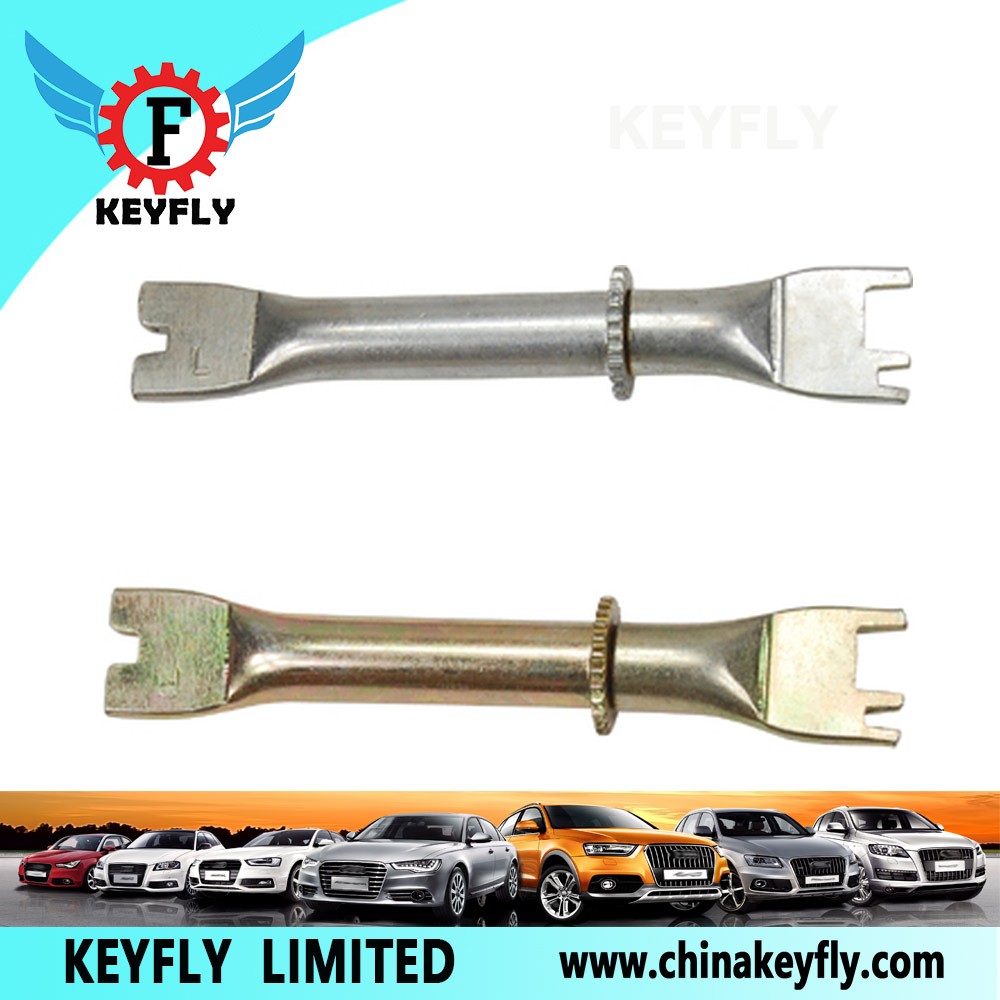
As drum lining wears, the shoes must travel further to reach the drum, so pedal travel grows and braking becomes uneven. A brake adjuster — the toothed strut between the two shoes — lengthens in small steps to hold clearance near its design value. Many vehicles have a ratchet pawl that takes up slack automatically when the parking brake is applied; on others the star wheel must be turned through the backing plate slot at service intervals.
- Adjusters are handed. Left and right units use opposite thread direction, so they are supplied and sold in pairs.
- The star wheel, threads and pawl wear out before the lining does; a seized adjuster either holds the shoes off the drum or keeps them dragging.
- On air-braked trucks the term means something else: the slack adjuster is the lever that turns the S-cam, checked by pushrod stroke rather than a star wheel.
Symptoms That Point to the Adjuster, Not the Lining
- Long pedal or handbrake travel while the linings are still above minimum thickness.
- One wheel braking later than the others, or a drum that runs hot after a short drive.
- Lining worn at one end only, or a shoe sitting at an angle inside the drum.
What a Wholesaler Should Keep on the Shelf
Most drum brake jobs need hardware, not only friction material. Stock adjuster struts, return and hold-down springs, pins and clips as complete kits per model — a workshop forced to order one spring separately will buy the whole set elsewhere next time. Coverage beats depth: a wide reference range across the pickups and light trucks used in Africa and Southeast Asia sells faster than a deep range on one platform.
KEYFLY lists 50 brake adjuster references, including repair kits, for Fiat, Ford, Isuzu, Mitsubishi, Nissan, Toyota and Hyundai applications — for example the Isuzu KBZ 2200 adjuster, referenced 8-94127077-0 and 8-94127078-0. The full range is on our brake adjuster category page; the single reference is on the KBZ 2200 adjuster page. Our brake range covers adjustment hardware; friction material is quoted on request.
Fitting Notes That Prevent Comebacks
- Lubricate the threads and star wheel with high-temperature brake grease, never ordinary chassis grease.
- Replace return springs that have stretched — reusing them defeats a new adjuster.
- Back the star wheel off until the drum slides on with light drag, then set it to the manufacturer specification.
- Road test and check drum temperature at each wheel before release.
Buyers needing help matching a model or OEM number can send their list to our sales team.
About KEYFLY LIMITED
KEYFLY LIMITED (www.chinakeyfly.com) is a professional exporter of automotive spare parts — air filters, car locks and ignition switches, brake slack adjusters, body parts and wiper blades — serving distributors and wholesalers in Africa, South America, and Southeast Asia. Contact: vicky@chinakeyfly.com


